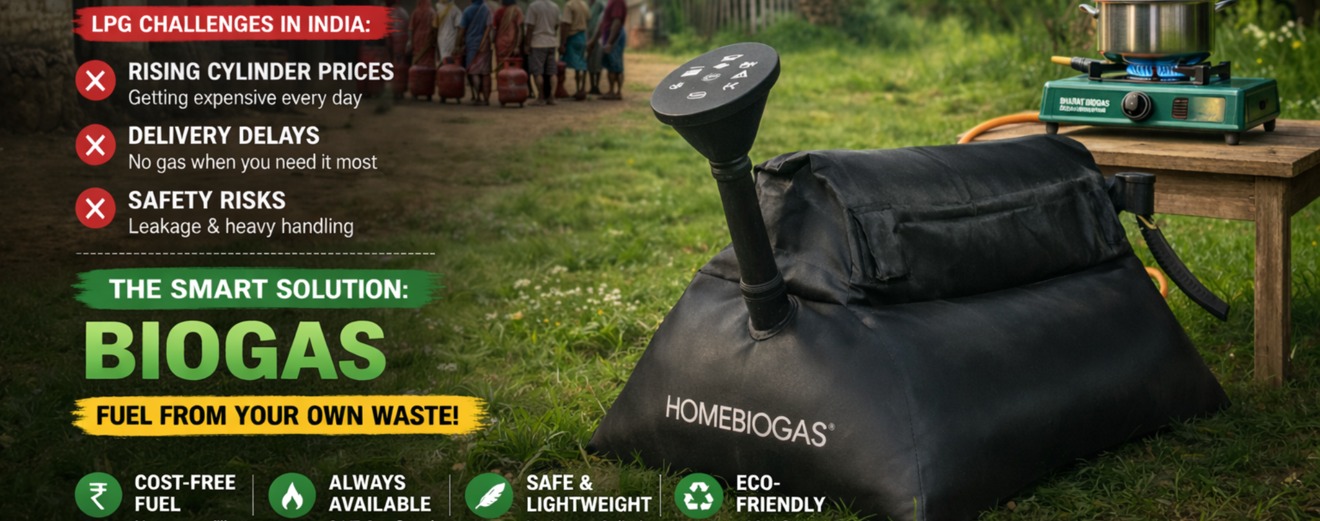
In 2026, millions of Indian households and small businesses are asking the same question:
What happens when your LPG cylinder doesn’t arrive on time—and what if prices keep going up?
India’s LPG crisis is no longer theoretical. Supply gaps, rising LPG cylinder price shocks, and distribution bottlenecks have turned cooking‑fuel planning into a monthly gamble for homes, farms, and commercial kitchens.
Biogas is stepping in as the strategic, low‑risk alternative to this imported‑fuel dependency. It’s not just “eco‑friendly”; it’s an energy‑security tool that converts waste into gas, stabilizes operating costs, and builds decentralized, resilient fuel ecosystems.
Why the West Asia War Is Causing India’s LPG Shortage in 2026
If you’re seeing LPG cylinder shortages, delays in LPG gas booking, and rising LPG cylinder prices in 2026, the real reason runs far beyond local distributors or “bad luck.”
The root cause lies in the war in West Asia.
India depends heavily on imported LPG, most of it coming from Qatar, Saudi Arabia, UAE, Kuwait, and Oman. Almost all these shipments must pass through the Strait of Hormuz, a narrow sea route between Iran and the Arabian Peninsula.
When tensions escalated between Iran, Israel, and the United States in early 2026, attacks, warnings, and maritime disruptions turned this route into a high‑risk zone. Many tankers either stopped sailing, delayed shipments, or rerouted at higher cost. Insurance and freight charges shot up, and shipments slowed down or got held up.
Result:
- LPG supply to India shrank suddenly.
- LPG cylinder prices went up because every imported shipment was more expensive.
- Shortages spread from commercial kitchens to households, especially in cities like Bengaluru, Delhi, Mumbai, and Kolkata.
What is driving India’s LPG crisis in 2026?
The LPG crisis in 2026 is a mix of three factors:
1. Import dependence
- India imports a large share of its LPG, so global price shocks pass straight to LPG cylinder price.
- In many cities, a 14.2 kg cylinder now costs ₹900–₹1,100, with spikes during geopolitical tensions.
2. Distribution bottlenecks
- From depots to distributors to last‑mile delivery, every step can jam.
- LPG cylinder news in 2026 repeatedly highlights shortages, delayed refills, and black‑market pricing.
3. Rising demand
- More homes and small businesses are using LPG as a clean‑cooking option.
- LPG gas booking systems are digital, but that doesn’t fix physical supply constraints.
For families, this means stress when the cylinder is late.
For businesses, it’s risk to operations and margins.
Biogas vs LPG
LPG depends on global supply chains. Biogas depends on your own waste stream.
Key comparison points:
- LPG
- Fossil‑fuel‑based, imported.
- Prices are volatile and globally indexed.
- Supply chain is centralized and fragile—any disruption can cause shortages.
- Biogas
- Locally produced from organic waste (kitchen scraps, cow dung, farm residues, municipal wet waste).
- Once installed, input (waste) is often free or low‑cost; maintenance is relatively simple.
- Acts as a cost‑hedging mechanism and energy‑risk mitigation tool.
In other words, LPG = imported fuel risk; biogas = local fuel control.
Types of biogas systems relevant in India (2026 context)
Biogas technology in India now covers three main scales, each suited to different user profiles:
1. Household biogas plants
Small‑scale biogas digesters (often 1–2 m³) are commonly installed in rural homes and small farms. They use cow dung and kitchen waste as feedstock and can supply enough gas for basic cooking needs for 3–5 hours a day.
These systems are ideal for energy‑conscious households that want to reduce LPG dependence and manage animal or kitchen waste effectively. In 2026, many families in Kerala, Maharashtra, Karnataka, and Gujarat are reviving or upgrading such plants in response to LPG shortages.
2. Community biogas plants
Community‑scale plants (10–100 m³) are set up for housing societies, panchayats, and small town clusters. They collect mixed organic waste from households and local markets and convert it into gas that can be distributed through a mini‑pipeline network or stored in gas holders.
Such systems are particularly useful for apartment complexes, temple or community kitchens, and small towns where centralized waste management is weak but biogas demand is high.
3. Commercial and industrial / CBG plants
At the industrial level, larger biogas and bio‑CNG (CBG) plants process tonnes of agri‑waste, municipal wet waste, or dairy‑farm slurry daily. The gas can be upgraded to bio‑CNG and used as vehicle fuel, or fed directly into boilers, generators, or industrial kitchens.
In 2026, several CBG clusters and bio‑CNG projects are coming up across states like Gujarat, Maharashtra, and Karnataka, partly driven by the LPG crisis and supported by government incentives. These plants are a natural fit for industries, hotels, and large institutions that want to cut fuel costs and reduce their carbon footprint.
| Scale | Typical feedstock | Output use | Example users |
| Household | Dung, kitchen waste | Cooking, lighting | Rural homes, small farms |
| Community | Mixed organic waste | Cooking, small heating | Panchayats, housing societies |
| Industrial/CBG | Agri‑waste, wet municipal waste | Bio‑CNG, heat, power | Farms, hotels, industries |
Biogas vs LPG: key advantages for India
If LPG is the imported, high‑cost, high‑security‑risk fuel, biogas is the local, waste‑based, resilient alternative. Here’s how they compare in the Indian context:
Cost over time
- Once a biogas plant is installed, waste is the main input—often free or low‑cost.
- Over time, LPG savings are substantial, especially for farms, hotels, and community kitchens.
- LPG prices are linked to global markets, remaining volatile and prone to sudden spikes.
Biogas acts as a cost‑hedging mechanism against LPG volatility.
Supply reliability
- LPG supply depends on refineries, import terminals, and long logistics chains—every node can fail.
- Biogas is produced on‑site or nearby, making it far less vulnerable to supply‑chain breakdowns.
For industries and municipalities, this means reduced operational risk and better continuity of heat and power processes.
Environmental and health benefits
- Burning LPG is cleaner than wood or kerosene, but still emits CO₂ and depends on fossil‑fuel extraction.
- Biogas, produced from organic waste, offers near‑net‑zero carbon benefits and reduces methane emissions from landfills.
Replacing firewood or kerosene with biogas improves indoor air quality, reducing respiratory health risks for women and children.
Waste‑management synergy
Biogas plants convert wet organic waste into gas and rich slurry, which can be used as fertilizer. This reduces the volume of waste going to landfills and lowers municipal collection costs.
In 2026, many cities are exploring biogas as part of integrated waste‑to‑energy strategies, combining it with existing solid‑waste management and BMS‑style monitoring systems.
Biogas vs LPG: cost snapshot
| Scale / Use‑case | Typical LPG‑cost impact | Biogas savings potential* | Payback period range |
| Household | ₹1,000–₹1,500/month | 20–40% reduction | 2–4 years |
| Community kitchen | ₹3,000–₹7,000/month | 30–60% reduction | 3–7 years |
| Commercial / industrial | ₹10,000–₹50,000+ per month | 50–80% reduction | 4–8 years |
*Savings depend on plant efficiency, feedstock quality, and local LPG prices.
This is where biogas moves from “green experiment” to board‑level energy‑cost optimization.
Real‑world examples in India
Kerala & Mumbai → Household resilience
Many families in Kerala and Mumbai are reactivating or upgrading old biogas plants as LPG prices rise and supply becomes unreliable.
- Even a small household plant can replace 1–2 LPG cylinders per month, saving ₹1,500–₹2,500 per year at current prices.
- This is household‑level energy independence, built on waste the family already manages.
Pune → Commercial kitchen optimization
In Pune, community kitchens and hotels use “Vaayu”‑style biogas plants that convert hotel kitchen waste into cooking gas.
- Some hotels report 20–30% reduction in LPG consumption during peak months.
- The biogas slurry is used as fertilizer in nearby farms or gardens.
For commercial kitchens spending ₹10,000–₹20,000 per month on LPG, this level of saving turns biogas into a practical energy‑cost hedge, not just an ESG initiative.
Anand (Gujarat) → Rural gas networks
Around 100 villages in Anand district feed a bio‑CNG cluster powered by biogas plants.
- This model converts small‑scale rural biogas into a regional energy backbone.
- It reduces dependence on imported LPG and stabilizes fuel costs for homes and small industries.
These examples show that biogas is not a theoretical solution; it is already working on the ground and scaling rapidly in response to the LPG crisis.
How biogas supports India’s energy security and policy goals
India is pushing several policy levers to support biogas and bio‑CNG:
- SATAT and CBG policies
- Create off‑take agreements and blending targets for bio‑CNG.
- Enable long‑term, predictable fuel markets for biogas plants.
- Rural and biogas‑subsidy schemes
- Many states offer partial or full capital subsidies for household and community biogas plants.
- These schemes reduce upfront CAPEX and shorten payback periods.
From a decision‑maker’s perspective, biogas is:
- Energy‑security infrastructure.
- Cost‑hedging mechanism against LPG volatility.
- Decentralized infrastructure that aligns with digital‑era energy planning.
Operational considerations (not “risks”)
Transitioning to biogas is about smart planning, not avoiding risk. Here are the key operational factors to engineer into your project:
- Design variables
- Correct plant sizing for daily LPG consumption.
- Matching feedstock availability (dung, kitchen waste, farm residues) with required gas output.
- Planning factors
- Space and land for digester, slurry storage, and access for maintenance.
- Urban waste‑collection logistics for community and city‑scale plants.
- Skill and awareness
- Training for daily operation, feeding, slurry management, and safety checks.
These are engineerable constraints, not show‑stoppers—especially when you work with a biogas‑to‑revenue platform that handles design, permitting, and O&M.
How Sigma Power Tech can help
At Sigma Power Tech, we specialize in designing, installing, and optimizing biogas systems for homes, farms, hotels, and industries. Our solutions are tailored to:
- Assess your LPG consumption and recommend a biogas plant size that matches your needs.
- Integrate biogas plants with existing energy and waste‑management systems, including BMS‑style monitoring for industrial clients.
- Provide end‑to‑end support, from feasibility studies and design to installation, commissioning, and training.
If you are looking to reduce LPG dependence, cut fuel costs, or convert organic waste into value, we invite you to request a biogas feasibility study or a site‑specific plant design consultation.
FAQs:
Q. Is biogas as effective as LPG for cooking?
Ans. Yes. Biogas burns cleanly and can be used in specially designed or modified cooking appliances. Many households report comparable cooking performance, with the added benefit of waste‑to‑fuel conversion.
Q. How much LPG can a biogas plant replace?
Ans. The replacement depends on plant size and feedstock. A small household plant may replace 1–2 LPG cylinders per month, while a larger community or industrial plant can replace dozens of cylinders per day.
Q. What is the average cost of a biogas plant in India?
Ans. Costs vary widely by size and type. Small household plants typically range from tens of thousands to a few lakhs of rupees, while large commercial or CBG plants can cost several lakhs to crores, depending on scale and level of automation.
Q. Can biogas support commercial kitchens and hotels?
Ans. Yes. Many hotels and commercial kitchens in India are already using biogas plants to supplement or partially replace LPG, especially in regions facing shortages.
Q. What government subsidies are available for biogas plants?
Ans. Central and state schemes often provide partial capital subsidies for household and community biogas plants, as well as support for bio‑CNG and CBG projects. Exact terms vary by state and program, so a site‑specific subsidy assessment is recommended.